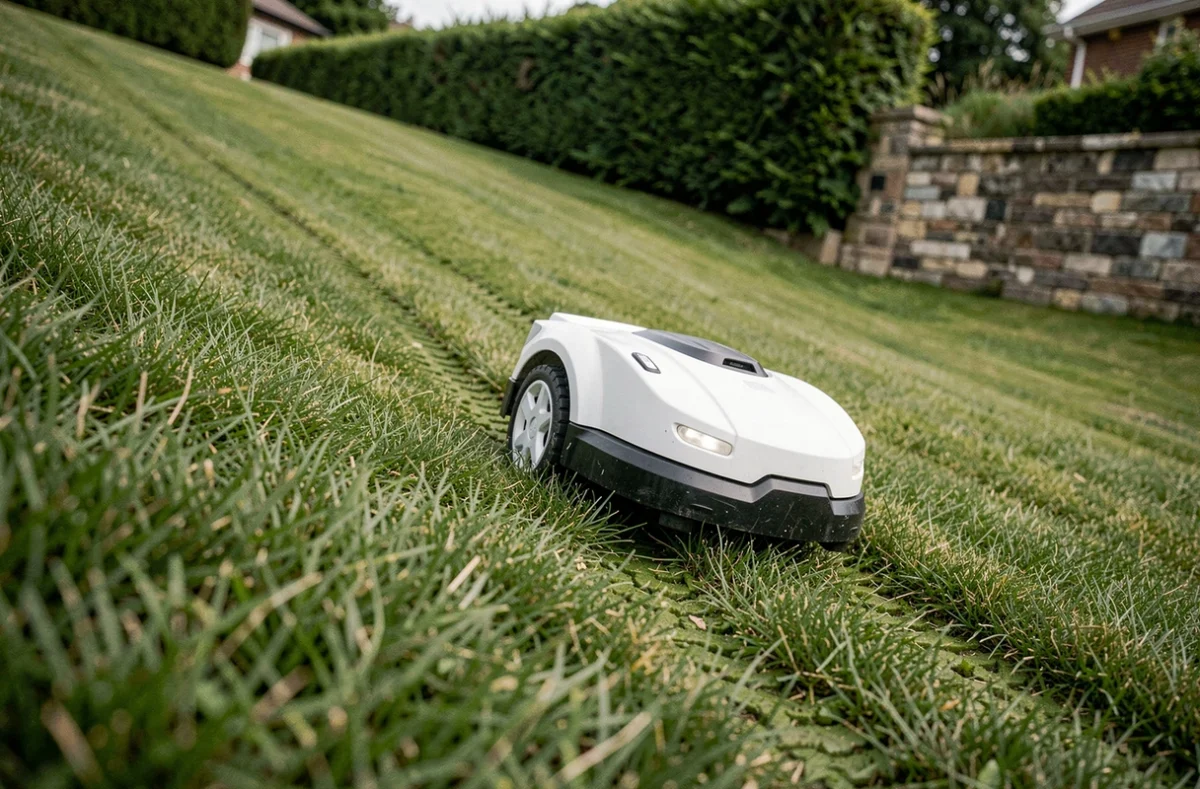
The crossing capacity displayed on a technical sheet does not predict the actual behavior of a robotic mower on slopes. The announced value is measured in a straight line, on dry grass, with a full battery. As soon as it needs to turn on a slope or follow a border, the actually usable slope decreases. Choosing a robotic mower for sloped terrain requires thinking beyond the marketing percentage.
Announced slope and usable slope: two distinct values
We regularly observe a gap between the theoretical maximum slope and the slope that the robot manages under real conditions. The comparison site Comparatif-robots-tondeuses.fr, updated in September 2026, explicitly distinguishes these two data points. A model announced for a steep incline may struggle on a moderate slope if the ground is soft, wet, or if the trajectory requires a sharp turn.
The critical slope is not the average slope of the garden, but the maximum local inclination, particularly near the zone boundaries and on the path to the charging station. Measure this specific point with an inclinometer (the smartphone app is sufficient), not the overall average of the terrain.
On wet ground, even a motorization that is well-sized for dry conditions guarantees nothing. Rain alters grip, causes slipping, and leaves wheel tracks. The criterion to check is not only the waterproofing of the chassis but also the stop-and-resume strategy after a downpour integrated into the software.
Several recent models incorporate a rain sensor coupled with a mowing delay algorithm, which helps avoid degrading the lawn. In practice, robotic mowers on sloped terrain that manage humidity well stand out more for their software than for their raw engine power.
AWD transmission and wheel profile: what matters on sloped terrain
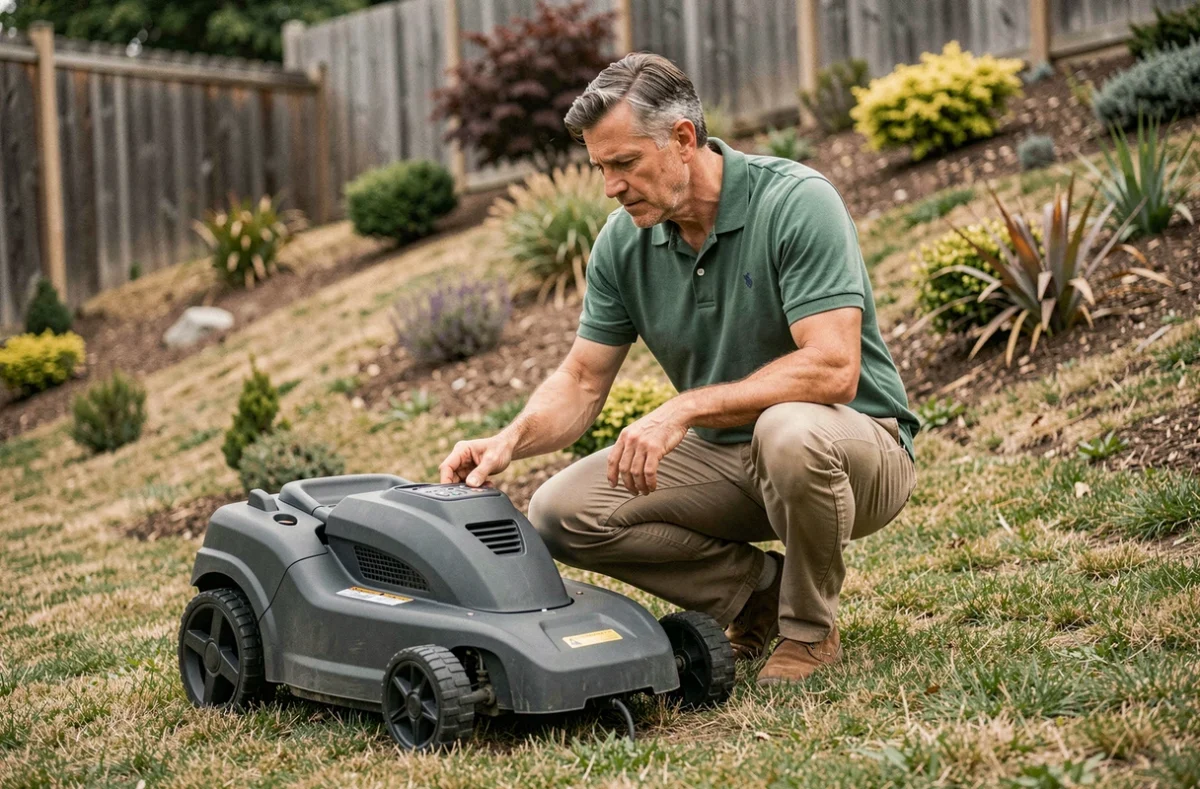
A four-wheel drive (AWD) robot is not a luxury on slopes, it is a prerequisite as soon as the inclination exceeds a moderate threshold and the terrain has irregularities. The difference with a two-wheel drive transmission is especially noticeable in turns: on a slope, the inner wheels lose grip and a 2WD robot begins to drift laterally.
The wheel profile is as important as the transmission. Wide wheels with deep treads maintain grip on wet grass and soft soil. Narrow and smooth wheels, even on an AWD chassis, slip as soon as conditions deteriorate.
Mechanical criteria to check before purchase
- Type of transmission (2WD or AWD) and torque per wheel, not just the overall announced power
- Width and tread of the tires, checking if the manufacturer offers optional wheels for difficult terrain
- Ground clearance of the chassis, which determines the ability to cross level breaks or roots without getting stuck
- Weight of the robot, as a model that is too light loses grip on slopes while a model that is too heavy marks the lawn
We recommend cross-referencing these criteria with the nature of the soil. Clayey terrain retains water and becomes slippery longer than well-drained sandy soil. The same robot may excel on one and fail on the other.
RTK navigation, LiDAR or vision: what guidance for wooded slopes
The choice of navigation system takes on a particular dimension on sloped terrain. A robot with RTK guidance alone loses precision under dense tree cover, as the satellite signal becomes unstable under the branches. If your garden combines slope and trees, a mixed navigation system integrating LiDAR or vision cameras compensates for satellite shadow areas.
Vision navigation (onboard cameras) is progressing rapidly. Several 2026 models combine vision and inertial mapping to maintain reliable positioning even without a GPS signal for several meters. This redundancy is particularly useful in gardens where the slope is precisely under the trees.
Navigation and management of mowing zones on slopes
A good navigation system does not just follow a trajectory. It adapts the mowing speed to the inclination in real time. The most advanced models automatically slow down when going uphill to preserve battery life and accelerate downhill while modulating braking. This dynamic management extends effective autonomy on hilly terrain compared to a robot that maintains a constant speed.
Mapping zones also allows for excluding areas that are too steep or too narrow where the robot might get stuck. We observe that users who take the time to configure precise exclusion zones significantly reduce manual interventions.
Autonomy and charging station: specific constraints for slopes
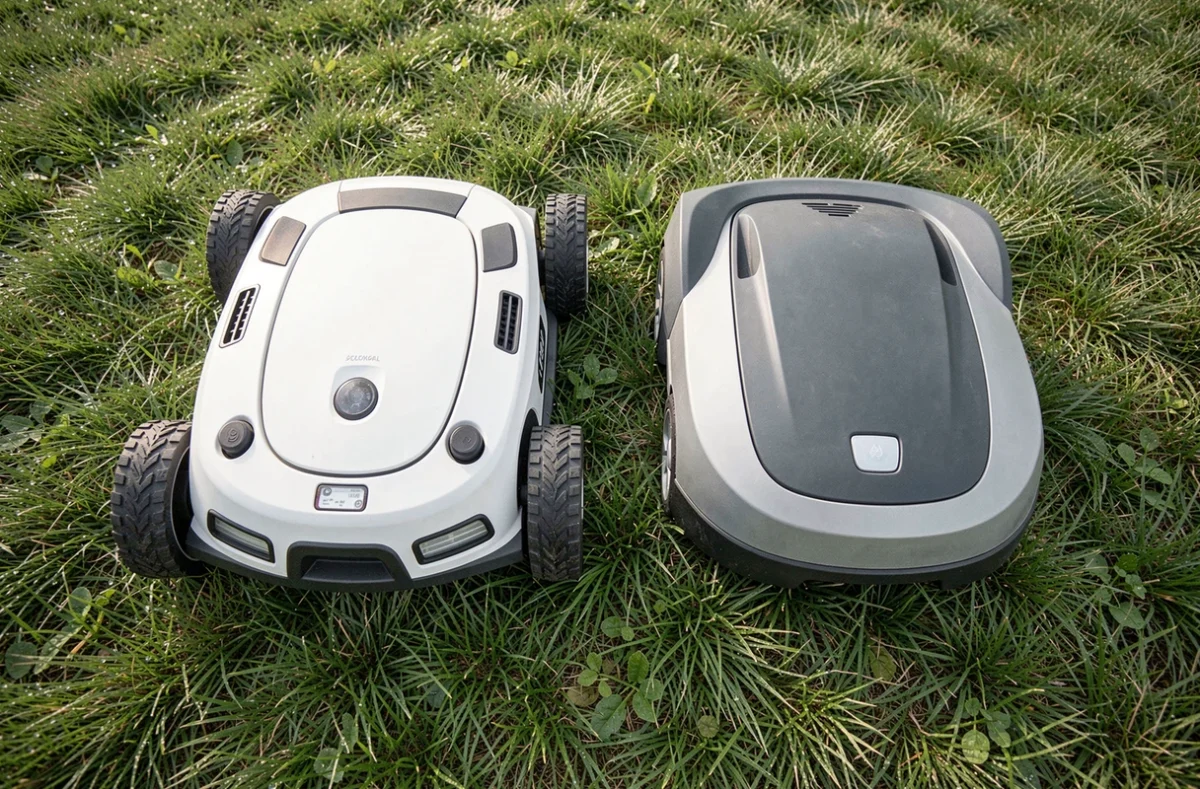
Mowing on a slope consumes significantly more energy than on flat terrain. The actual autonomy on slopes can drop by half compared to the announced autonomy on flat ground. This point is rarely highlighted in product sheets.
The location of the charging station deserves specific consideration. If the base is at the top of the slope, the robot consumes energy to climb back up with each charging cycle. If it is at the bottom, it must descend with a low battery, which can cause braking issues on some models. The ideal position is a relatively flat area, halfway or on the outskirts of the sloped zone.
- Check that the manufacturer indicates autonomy under sloped conditions, not just on flat ground
- Prefer a battery with a higher capacity than what the area alone would require, to compensate for the overconsumption related to the terrain
- Test the return to base under real conditions: some robots fail to find their station when the battery is very low on an uphill route
The sizing of the battery is the most underestimated choice for sloped terrain. Starting with a model designed for a larger area than yours provides the necessary energy margin without compromising mowing quality.
A robotic mower for sloped terrain should not be chosen based on a comparative specification table. The terrain dictates the choice: soil type, vegetation cover, maximum local inclination, seasonal humidity. Measuring, testing, and precisely configuring mowing zones remains the best investment even before comparing models.