
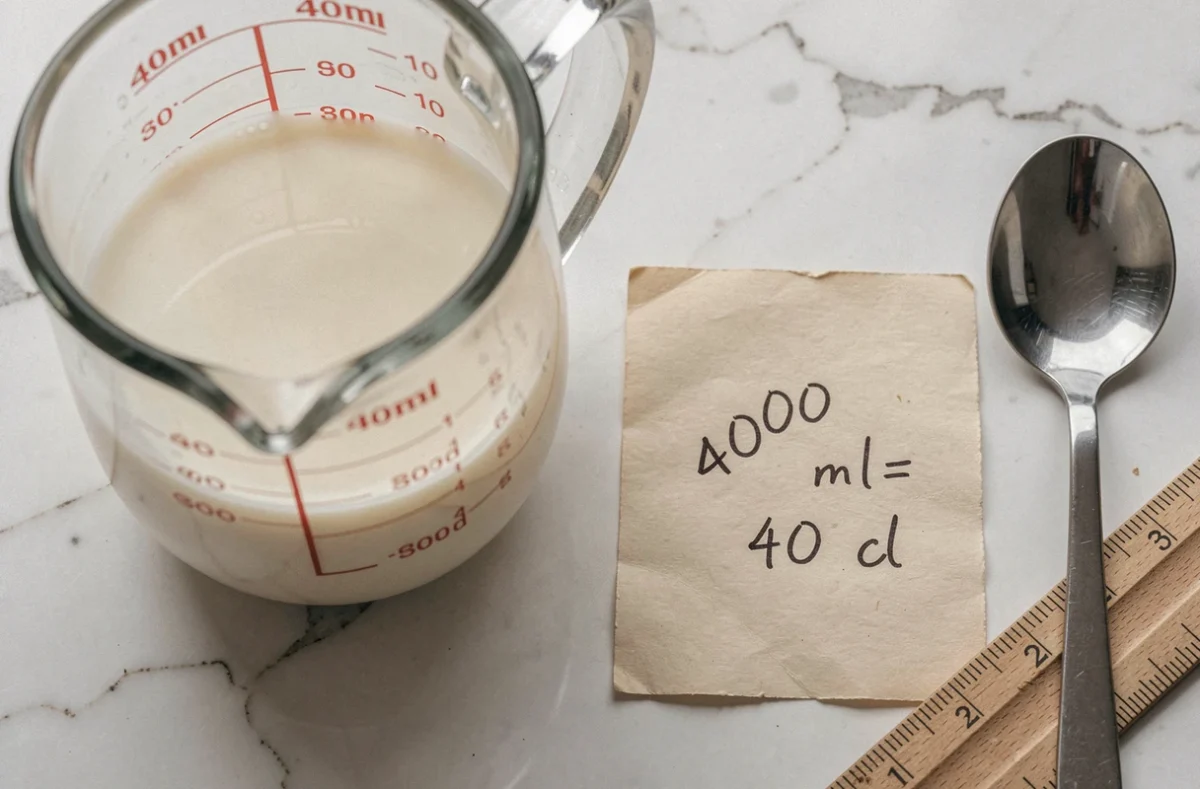
We have the milk carton in one hand, the measuring cup in the other, and the recipe states “400 ml of milk.” The problem: the measuring cup is marked in centiliters. No panic, the conversion is straightforward and requires no calculator. 400 ml of milk corresponds to 40 cl, and this rule applies to all liquids without exception.
When the recipe calls for grams of milk but you only have a measuring cup
The ml/cl conversion is simple. The real issue in the kitchen arises when the recipe asks for 400 g of milk while you only have a container marked by volume.
Milliliters and grams do not measure the same thing. Milliliters express a volume, while grams express a mass. For pure water, the ratio is nearly direct: 1 ml weighs about 1 g. Milk, however, contains proteins, lactose, and fats that make it slightly denser than water.
In practice, pouring 400 ml of milk into a measuring cup gives a bit more than 400 g. The difference remains small for a common cooking recipe. For a pancake batter or a gratin, one can consider that 40 cl in the measuring cup will suffice. In fine pastry (custard, ganache), a kitchen scale remains more reliable than a reading of the graduation.
If you are looking to convert 400 ml of milk into centiliters for a recipe, remember that the measuring cup is sufficient in the vast majority of cases, as long as you read the liquid level correctly.
Conversion ml to cl: the unique rule to remember
You divide by 10. That’s the only operation needed.
A milliliter is one-thousandth of a liter. A centiliter is one-hundredth of a liter. Therefore, one centiliter contains 10 milliliters. To convert from ml to cl, you divide the value by 10. For the reverse, you multiply by 10.
Applying the formula to 400 ml
400 divided by 10 gives 40. 400 ml = 40 cl, regardless of the liquid (milk, water, cream, juice). The volume does not change according to the nature of the product, unlike the mass.
Some useful benchmarks for cooking:
- 100 ml = 10 cl, which is a small mustard glass filled
- 250 ml = 25 cl, the classic capacity of a large glass or mug
- 500 ml = 50 cl, half a liter, or half of a standard bottle
- 1,000 ml = 100 cl = 1 liter
These equivalences cover almost all recipe needs. They can be found on most cartons and bottles in stores.
Reading a measuring cup correctly to avoid skewing the measurement
Having the correct conversion is useless if the volume reading is approximate. On a graduated container, the milk (like any liquid) forms a meniscus, a curvature at the surface of the liquid that slightly rises along the walls.
The reading is done at the bottom of the meniscus, at eye level, with the container placed on a flat surface. Looking from above or below skews the measurement by a few milliliters, which can matter for small quantities.
Graduations in cl or ml depending on the container
Measuring cups sold in France often display multiple scales: milliliters on one side, centiliters or deciliters on the other, sometimes with markings in cups or ounces for Anglo-Saxon recipes. Before pouring, identify the scale that corresponds to the unit requested by the recipe.
A measuring cup with graduations spaced by 50 ml offers sufficient precision for pouring 400 ml of milk. For smaller volumes (10, 20, 30 ml), a graduated cylinder or a kitchen syringe will be more reliable.

Quick conversion table for common milk volumes in recipes
Rather than pulling out the calculator at each step, this table groups the conversions most often encountered in cookbooks and culinary blogs:
| Milliliters (ml) | Centiliters (cl) | Common usage |
|---|---|---|
| 50 ml | 5 cl | Splash of milk in coffee, light sauce |
| 100 ml | 10 cl | Pancake batter for 2, quick béchamel |
| 200 ml | 20 cl | Individual flan, purée |
| 250 ml | 25 cl | Quiche, clafoutis |
| 400 ml | 40 cl | Family pancake batter, rice pudding |
| 500 ml | 50 cl | Pastry cream, gratin dauphinois |
| 1,000 ml | 100 cl | 1 liter, large quantity preparations |
The “common usage” column gives a rough idea, not a prescription. The exact proportions depend on each recipe.
After measuring: what to do with the remaining milk in the carton
A standard milk carton contains 1 liter. After taking 40 cl, 60 cl remain. The question of storage arises, especially if you rarely cook.
For unopened UHT milk, storage is done at room temperature under the conditions indicated on the packaging. After opening, the guidelines vary from brand to brand: the expiration date and shelf life are printed on the carton. It’s better to read the label than to rely on a general rule.
Pasteurized milk, on the other hand, is stored in the refrigerator before and after opening. It spoils faster, making it a less practical choice when only using part of the carton.
Remembering the conversion of 400 ml to 40 cl takes three seconds. The real difficulty in cooking is never the calculation; it’s knowing whether the recipe refers to volume or mass, and reading the measuring cup at the correct level. Once these two reflexes are acquired, conversions become automatic.