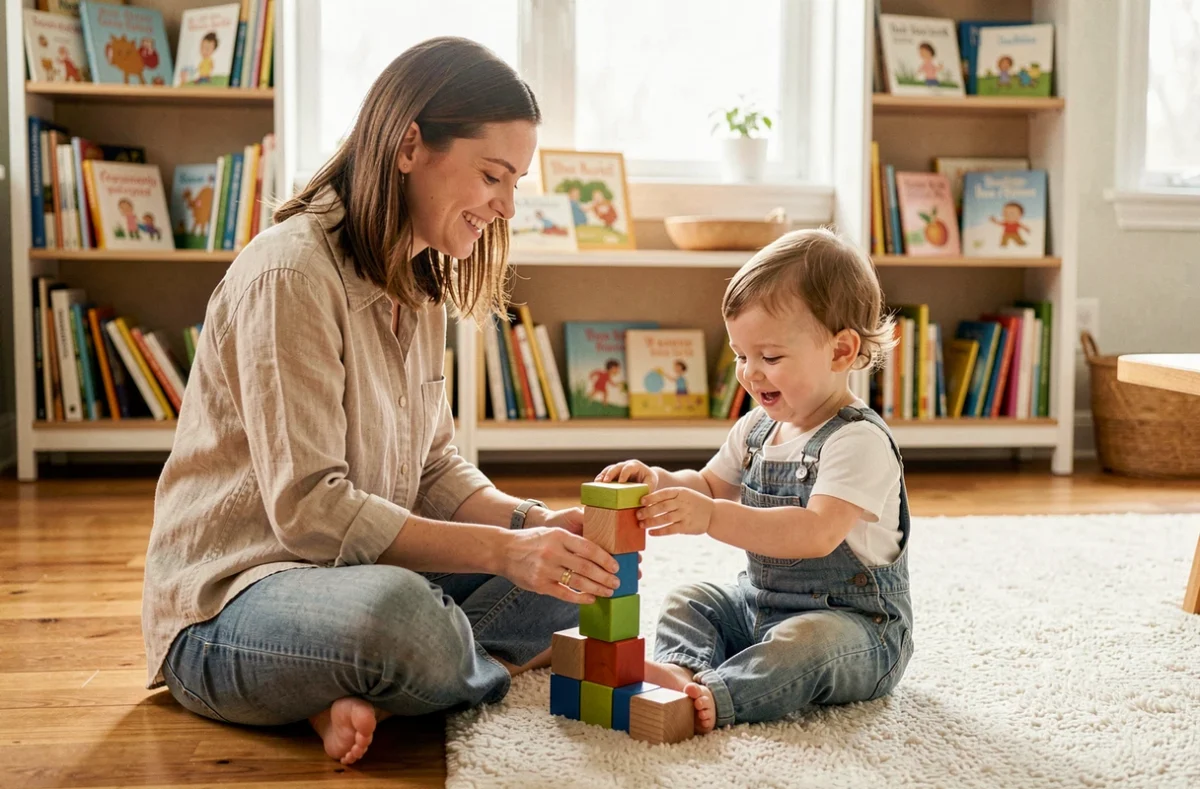
Your child grabs a spoon, turns it around in every direction, drops it, and then starts again. This repetitive gesture may seem trivial, but it engages their coordination, understanding of gravity, and ability to anticipate an outcome. A child’s awakening happens in these micro-moments of daily life, much more than in sophisticated activities.
Screens and Young Children: What the 2025 Regulation Changes
Have you ever noticed a toddler staring at a screen with unusual focus? This fascination does not indicate learning. A young brain captures the light and sound flow without being able to process the content as an adult would.
A decree published on June 27, 2025, prohibits exposing children under 3 years old to screens in daycare centers and childcare facilities. This measure goes beyond simple parental advice: it creates a legal obligation for early childhood professionals.
The new health booklet, distributed since January 1, 2025, includes questions about screen exposure starting at 3 months old. It also contains checklists for identifying neurodevelopmental disorders. These tools allow the doctor to open discussions with parents during follow-up visits.
The High Council of Public Health recommends evaluating the context of use rather than a universal hourly quota. The type of screen, the content viewed, the effects on sleep, and interactions matter more than a fixed number of minutes.
A child watching a short video with a parent who comments on what they see is not in the same situation as a child left alone in front of a tablet. To explore resources suitable for each age group, the children’s section of Vive Mon Bébé gathers concrete benchmarks on development and appropriate activities.

Sensorial and Motor Development: What Happens Before Words
Before speaking, a child learns through touch, movement, and exploration. Motor development precedes and prepares language. A baby manipulating objects of different textures refines their tactile perception, which gradually structures their understanding of the world.
Free Motor Skills Rather Than Directed Stimulation
Placing an infant on a firm mat, without securing them in a device, allows them to discover their supports. They learn to roll over, then to crawl, at their own pace. Each motor milestone achieved independently boosts their confidence and proprioception.
The common reflex is to position the child in ways they have not yet mastered (sitting propped up by cushions, standing in a walker). These artificial aids short-circuit intermediate motor stages that the body needs to go through. A child who has not crawled enough may face coordination difficulties later.
The Role of Everyday Objects
Specialized toys are not mandatory. A colander, stacking cups, or a crumpled piece of fabric can stimulate as much as a toy designed for awakening. What matters is the variety of shapes, weights, and textures offered.
- Light objects and heavier objects to experiment with grip strength
- Smooth, rough, and soft surfaces to refine touch
- Open containers (boxes, bowls) to practice the gesture of filling, emptying, and transferring
- Sound objects (rattle, wooden spoon on a pot) to associate action and result
The adult does not need to guide every manipulation. Observing without intervening is a form of support in itself.
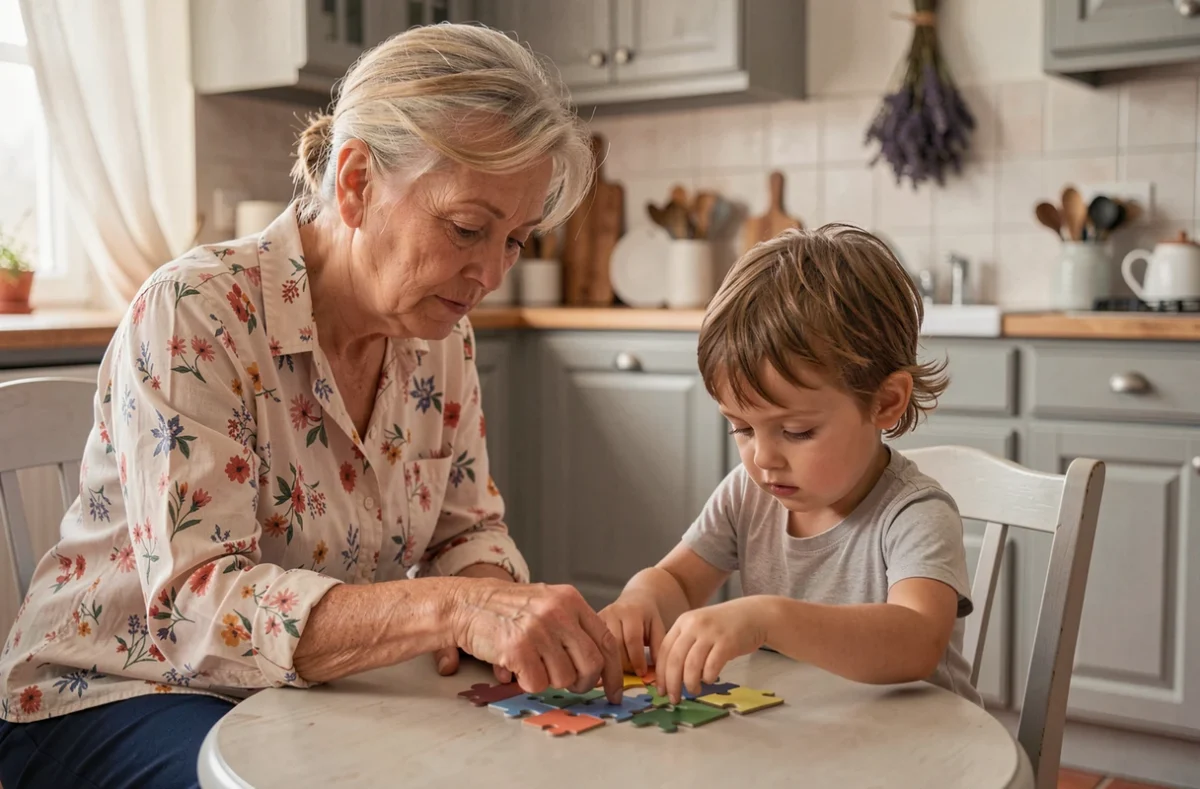
Child’s Language: Building Vocabulary Through Routines
Bath time, mealtime, dressing: these repetitive moments are the best allies of language development. The repetition of the same vocabulary in an identical context helps the child associate a word with an action or an object.
Why does this context work better than a picture book? Because the child experiences the situation. They feel the water, touch the towel, see the soap. The word makes sense when it accompanies a direct sensory experience.
Adapting Your Way of Speaking According to Age
With a baby a few months old, describing what you are doing is enough: “I’m putting on your bodysuit, one arm, then the other.” Around 18 months, you can pose simple choices: “Do you want the red cup or the blue one?” These micro-decisions engage understanding and encourage the first verbal attempts.
After 2 years, sentences can gradually lengthen. Reformulating what the child says incorrectly, without correcting them directly, provides a model. If they say “a tombé cuillère,” responding “yes, the spoon fell” gives them the correct structure in a natural exchange.
- Name objects and actions at the moment they occur, not afterwards
- Allow a pause after a question to enable a response, even if non-verbal
- Sing short nursery rhymes with associated gestures to anchor the rhythm of language
Social Interactions and Emotion Management from a Young Age
An 18-month-old child who snatches a toy from another is not being aggressive. They do not yet have the neural circuits necessary to understand another’s perspective. Empathy develops gradually, not before 3 or 4 years in most cases.
Putting words to what the child feels (“you are angry because he took your truck”) helps them identify their emotions. This verbalization by the adult is the first tool for emotional regulation. It far precedes the child’s ability to manage their frustrations independently.
Imaginative play (feeding a stuffed animal, playing doctor) often appears around 2 years old. It allows the child to reenact lived scenes and experiment with different roles. Symbolic play is a risk-free social laboratory.
Daily support relies less on methods and more on regular attention to the child’s signals. A sustained gaze, persistent babbling, a repeated gesture are all attempts at communication. Responding to them, even briefly, is enough to nurture the bond and support overall development.