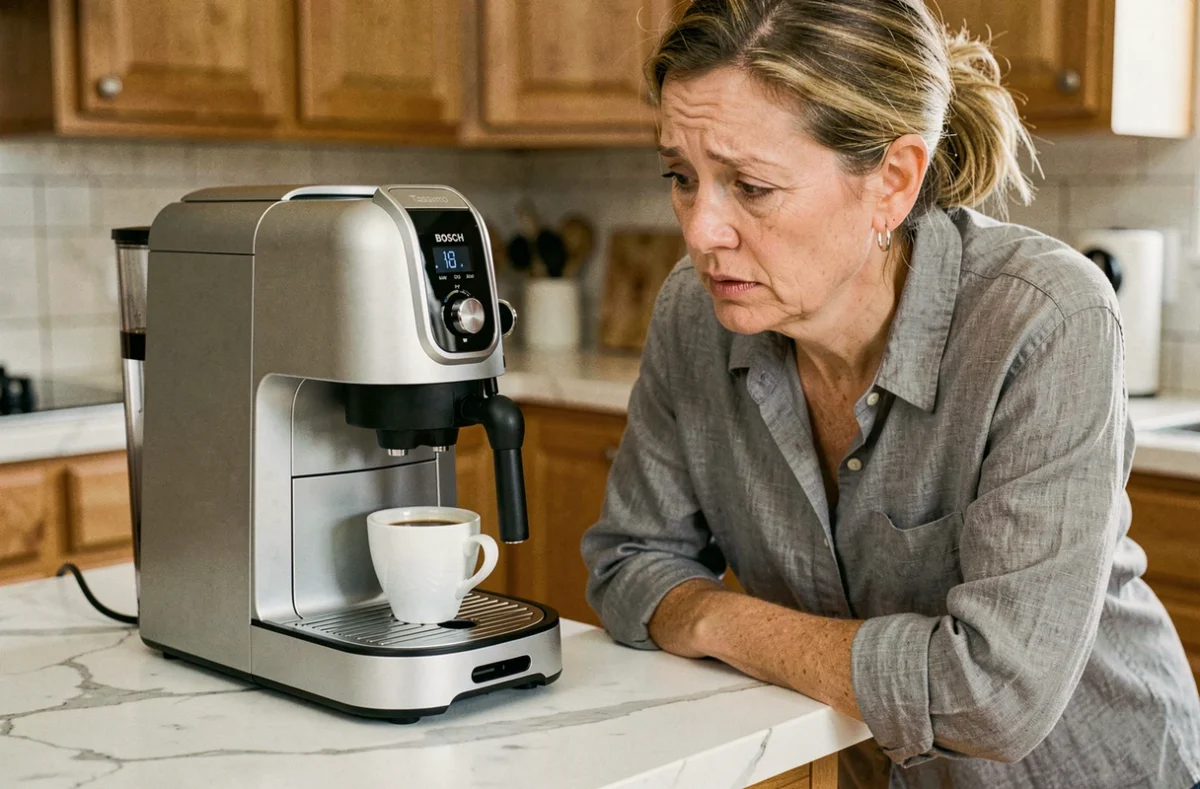
A Bosch Tassimo that only fills the cup halfway raises a simple question: what determines the volume of water injected? The answer involves the barcode of the T DISC, the state of the hydraulic circuit, and the specific model of the machine. Identifying which of these factors is at fault prevents unnecessary descaling of a device whose problem lies elsewhere.
Tassimo coffee volume: what the T DISC barcode really controls
Each T DISC carries a barcode read by the machine at the time of preparation. This code determines the amount of water, the temperature, and the brewing time. On entry-level models like the Vivy 2, no volume adjustment is accessible via a menu: the recipe is entirely dictated by the capsule.
A coffee that seems too short may simply correspond to the recipe intended by the T DISC used. Before looking for a malfunction, it is useful to test another type of capsule to compare the volume obtained.
In contrast, the My Way 2 offers recordable settings for volume, temperature, and intensity. On this model, an abnormally low volume after changing the capsule may indicate a custom setting retained in memory rather than a mechanical malfunction. When trying to resolve a Bosch Tassimo issue, distinguishing first what pertains to the T DISC and what pertains to the machine saves time.
| Factor | Entry-level models (Vivy 2, Happy) | Advanced models (My Way 2) |
|---|---|---|
| Volume determined by | T DISC barcode only | Barcode + recordable user setting |
| Possible adjustment | Hold the button to extend the flow or stop manually | Change volume, temperature, and intensity via the interface |
| Documented factory reset | Not described in the Bosch manual | Model-specific procedure |

Air pocket in the Tassimo hydraulic circuit: a problem distinct from limescale
Descaling is often the first reflex when coffee flows little. But an air pocket in the circuit reduces flow unrelated to limescale. The typical symptom: the pump runs normally, the noise is present, but the water drips out or comes out in irregular bursts.
This phenomenon occurs after a reservoir has been removed for a long time or poorly repositioned. The trapped air in the circuit prevents the pump from sucking properly.
Bleeding air from the circuit
Bleeding involves running water without a capsule, using the service T DISC provided with the machine. The reservoir must be filled and properly clicked into place before starting the cycle. If the flow gradually returns to its normal rate, the air pocket was indeed the cause.
Conversely, if the flow remains low after several bleed cycles, the problem points to another source: limescale buildup in the internal circuit or mechanical obstruction of the T DISC holder.
Water reservoir and T DISC holder: two often overlooked checkpoints
A poorly clicked reservoir can be enough to reduce coffee volume. The internal float of the reservoir indicates to the machine the available water level. If the reservoir is not correctly positioned, the float may signal a low level and limit the amount of water sent.
The T DISC holder also deserves inspection. Residues of coffee or dried milk can partially obstruct the injection or drainage conduits. Regular cleaning of this area, without abrasive products, helps maintain proper flow.
- Remove the reservoir, rinse it, check that the float moves freely, then replace it until it clicks into place
- Inspect the capsule holder and remove any visible residue around the T DISC piercing needles
- Start a cycle with the service T DISC after reassembly to validate the flow
Tassimo Bosch descaling: when it is really necessary
The descaling indicator (symbol “calc” or spray depending on the models) lights up based on an internal counter, not a real measurement of limescale. Descaling remains the relevant solution when the flow gradually decreases over several weeks, without an identifiable triggering event such as a removed reservoir or a capsule change.
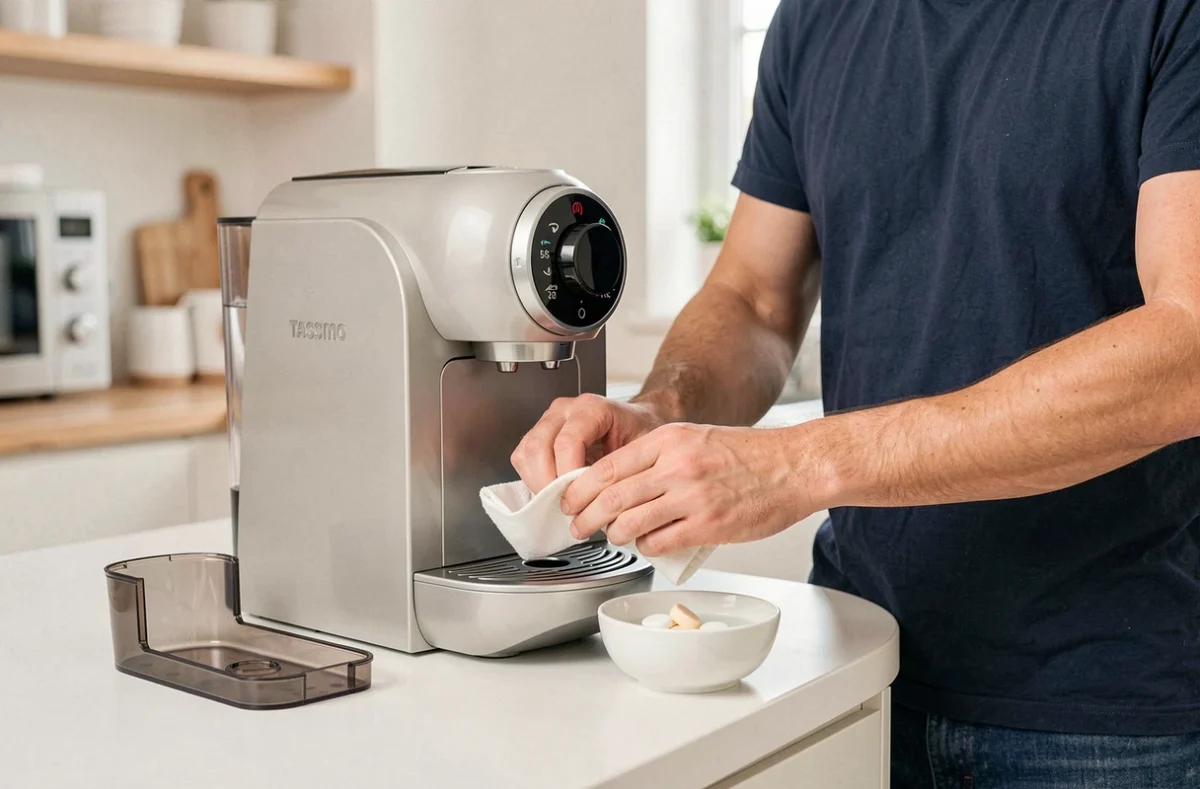
For effective descaling, Tassimo sells specific tablets. The cycle is started with the service T DISC, the reservoir filled with water, and the tablet dissolved. The process usually lasts two complete cycles followed by rinses with clear water.
Frequency and water used
In areas where the water is very hard, descaling may be necessary more often than the indicator suggests. Using filtered water in the reservoir slows down limescale formation. Some models like the My Way 2 integrate a Brita filter directly into the reservoir, which reduces the frequency of necessary descaling.
Tassimo reset: what the Bosch manuals really provide
Many “reset” procedures circulate online for Tassimo machines. The Bosch manuals for the Vivy 2 and Happy models do not describe a return to factory settings. What these guides call “reset” most often corresponds to unplugging followed by a bleed with the service T DISC, which amounts to clearing the air from the circuit.
On the My Way 2, the situation differs: the volume and temperature settings recorded by the user can indeed be reset via a procedure described in the manual. Confusing the two cases leads to unnecessary manipulations on entry-level models.
- Vivy 2, Happy, Style: unplug, wait a few minutes, plug back in, start a bleed cycle with the service T DISC
- My Way 2: consult the manual for the procedure to reset custom settings
- All models: if the problem persists after bleeding and descaling, contact Bosch customer service before any disassembly
The volume of a Tassimo coffee primarily depends on the inserted T DISC, then on the state of the hydraulic circuit. Testing another capsule, bleeding the air, and checking the reservoir resolve the majority of cases of small coffee. Descaling is only useful in the absence of another identifiable cause.